Friday, 13 April 2012

St John's Pro-Life get together again

Left to right: Niki, Katherine and Demelza
On Wednesday night those members of the group who could got together for one of our regular St John's Pro-Life Group meetings.  It's rare for all Group members to be able to meet up at the same time and Wednesday was no exception, but it was a very profitable gathering nonetheless.  Chief on the agenda were remembrance, awareness-raising and almsgiving.

Remembrance took the form of discussing planting plans for the plot of the Memorial for Unborn Children in Hills Farm Cemetery, Horsham.  I can't say "our" Memorial, firstly because it wasn't instigated by us (the now-defunct Horsham SPUC branch worked hard to fundraise for and erect it some years ago) and secondly because we would like to encourage a shared sense of ownership of the Memorial amongst all St John's parishioners, the town of Horsham and anyone who has a little person to remember.  However our Group has taken on the task of "refurbishing" the somewhat neglected plot.  After months of talking (by us) and hard digging (by Stella and her daughter Becka) it seems that planting may now be just weeks away!  If you look hard you can see that the girls in the photo are poring over a book of roses lent to us by Stella.  They may look knowledgeable but they're only pretending.  None of us in attendance on Wednesday had much of a clue really and we're referring the drawing up of the planting plans to Stella and to Demelza's gardener friend Paula.

OK girls, who are you kidding?
Awareness-raising involved talking about our regular parish newsletter and about this blog.  Are there particular topics you'd like to see covered or questions you'd like answered?  Let us know in the combox.

We also discussed leafleting.  I have done door-to-door leafleting in the past and I'll be honest, I find it SCARY.  My personal approach is to push the flyer into the letterbox as quickly as possible and then speed-walk down the drive (actual running would look silly and, as an unpractised person who on principle never runs unless being chased by plague-spreading zombies, I'd probably fall over)... after which I scuttle along to the next house hiding my clutch of leaflets under my cardigan, emanating guilt and embarassment yet kidding myself I look casually nonchalant.  I have been known to stoop as low as to send my sons, in their much younger days, to do it instead, on the grounds that no-one round where we live is likely to hurl abuse and eggs at children.

More seriously and less selfishly, there's also the question of how a leaflet is worded (short, snappy and attention-grabbing can easily become either superficial or harsh and intolerant-sounding) and of whether putting a necessarily limited message on a piece of paper through someone's door is the best context for raising awareness of certain complex and sensitive issues.

In the end, we decided that - if our clergy think it appropriate - we will distribute one of SPUC's latest leaflets within our parish.  It's been designed to tie up with the journey of the Olympic torch and you can find out about it here.  We liked it; it's attractive, simple but not simplistic and includes a brief summary of the development of the unborn child within the womb, and the topical link-up grabs one's attention.

Almsgiving - well, it's not Lent any more but of course this should be an ongoing part of Christian life. Over the months and years our Group aims to support a range of local charities in turn, not only because we'd like to help and to raise awareness of them, but also in order to broaden the concept of "pro-life" - many people tend to think of it rather narrowly, as being confined to opposing abortion and maybe euthanasia.  I and my family already have great reason to be thankful to the Group for their support of "Aila's Fund"; other causes we'd like to support include a local hospice and the town's crisis pregnancy centre, a disability awareness group and a ward of the local hospital.  It's all part of protecting, nurturing and celebrating human life at every stage and in all the diversity of situations this world throws at us.

Fittingly, Katherine opened and closed the meeting in prayer.  We invite anyone reading this blog to join with us in praying for the whole gamut of pro-life causes from conception to natural death.

Queen of Heaven, rejoice, alleluia.
For He whom you did merit to bear, alleluia.

Has risen, as he said, alleluia.
Pray for us to God, alleluia.

Rejoice and be glad, O Virgin Mary, alleluia.
For the Lord has truly risen, alleluia.

Let us pray. O God, who gave joy to the world through the resurrection of Thy Son, our Lord Jesus Christ, grant we beseech Thee, that through the intercession of the Virgin Mary, His Mother, we may obtain the joys of everlasting life. Through the same Christ our Lord. 
Amen. 

Regina coeli, laetare, alleluia.
Quia quem meruisti portare, alleluia.

Resurrexit sicut dixit, alleluia.
Ora pro nobis Deum, alleluia.

Gaude et laetare, Virgo Maria, Alleluia,
Quia surrexit Dominus vere, alleluia.

Oremus: Deus qui per resurrectionem Filii tui, Domini nostri Iesu Christi, mundum laetificare dignatus es: praesta, quaesumus, ut per eius Genetricem Virginem Mariam, perpetuae capiamus gaudia vitae. Per eundem Christum Dominum nostrum.
Amen.

Thursday, 12 April 2012

Euthanasia? Choose hope instead

Thanks to a post on John Smeaton's blog I've just taken time out to listen to an amazing BBC World Service interview with Alison Davis. Born with spina bifida, Alison had for many years a fixed desire to die but is now a passionate anti-euthanasia activist and national coordinator of No Less Human, a division of SPUC which works to raise awareness of the value of the lives of the disabled (see our sidebar).  Please do go here and listen too because it's a truly inspiring and moving interview.

Though raised a Christian in the Protestant tradition, Alison was for many years an atheist and even when she decided to explore the possibility that believers in God might be onto something, Catholicism was the last religion that she wanted to have anything to do with.  As you will guess, she is now a committed Catholic! Her conviction of the redemptive value of suffering when united to that of Christ on the Cross (she is in more or less constant and often agonising pain) is one of the factors that has made her feel life is worth living.

However, she describes other factors too which are not necessarily dependent upon a religious faith.  One initial turning point came after a visit to some disabled children in India when she turned to her carer, Colin, and said, "I think I might just want to live.  I think I could help these children."  She had, she says now, started to think about what she could do for others despite her circumstances, not what they could do for her.  She is rightly convinced that even those who are quite incapacitated can be of immeasurable value and help to others, simply by giving them opportunities for compassion and service and thus bringing out the best in them.

In a similar vein, she draws out the importance of human support and companionship in making life worth living.  She describes moments of friendship and laughter, of real joy, that have meant so much to her, particularly after the advent of her carer Colin into her life (as a student he offered to help her for a fortnight, and is still her carer 23 years later.  His testimony about how serving Alison has changed his life and formed his character is moving in its own right).  She had been lonely, she says, and it was partly for that reason that her suffering seemed unbearable, though she mentions the caring attentions of friends over the years which actually led to her life being saved after suicide attempts.

Above all, Alison says, we all need hope, and we are able to carry on living and finding a meaning in life if we have it.  Euthanasia robs people of hope by suggesting that death is the only way forward, but none of us "can second-guess what is round the corner". 

She also points out that euthanasia is never a decision that involves only one individual. Like abortion, like marriage, the debate about euthanasia is something that concerns society as a whole and once you allow it for one person, others are inevitably affected.  Therein lies a clarion call: because society as a whole is involved, then society (i.e. each and every one of us) should be looking for ways to carry other people's burdens, not dispose of those people as though they were burdens themselves.  As Christians, we follow Christ in so doing. "Surely he took up our infirmities and carried our sorrows..." (Isaiah 53:4)

Like Ruth Pakaluk (see previous post), Alison is a pro-life heroine, a saint in the making for our times, and like her she is someone who it is not beyond any of us to emulate.   Thank God for her example and her courage.

Wednesday, 11 April 2012

A pro-life read

Worth a read
A friend recently lent me The Appalling Strangeness of the Mercy of God to read.  It's the story of Ruth Pakaluk, of interest to me because she was both a convert to the Catholic faith and a pro-life activist (and short in height!!).  Mother of seven and such a powerful pro-life debater that after a while Planned Parenthood spokeswomen would not go up against her in public, she died at the age of 41 from metastasised breast cancer.

The book is edited by her husband, Michael Pakaluk, and consists mainly of Ruth's own letters written across a period spanning from her college days in Harvard, a spell in Edinburgh and then through many years when she seemingly managed to be both mum and pro-life activist each on a full-time basis in Worcester, Massachusetts.

The book's cover quotes Michael, saying, "Greatness can indeed be shown by a housewife and homemaker, and, furthermore, it might be more readily apparent under conditions of weakness, suffering, and death."  As a member of Opus Dei Ruth would certainly have had a huge heart for the sanctification of herself and the world through her everyday routine and I began reading eagerly, looking to meet someone inspirational I could identify with in my own humble state of life.  However it quickly became apparent that Ruth was no ordinary "housewife and homemaker"; not only was there her Harvard education, but her intelligence evidently had a very intellectual cast, she was terrifyingly articulate and she seemed to be possessed of staggering amounts of talent, determination and willpower in every area.  I did wonder if, had I known her, I might have found her a little intimidating!

St Josemaria, pray for us
Having said this, she certainly shines as a beacon of faith and as an example of what can be achieved through trust in God in outwardly very ordinary circumstances.  When she died there was a call in her home town of Worcester for her cause for sainthood to be put forward.  The various domestic details in her letters, including such identifiable-with incidents as expressing her frustration with a teenage son who dumps his dirty laundry in screwed-up bundles around his room, her particular interests and hobbies, and the very "human" aspects of her character such as a tendency to be very forthright and outspoken, all witness to the fact that Saints too are flawed and fallen human beings whose great virtue is to have abandoned themselves to God and allowed themselves to be channels of His goodness and power to the world in just the same sorts of situations that we all find ourselves in.

Peter Kreeft, who writes an introduction to the book, remarks that Ruth was "always cheerful" even when, in the midst of pain, she laboured at her pro-life work and brought up her large family, "working harder for the culture of life while in poor health than most people ever work when in perfect health".  He comments, "Like Mother Teresa.  Like John Paul II.  They show us that cheerfulness is neither a temporary feeling nor a genetic predisposition but a choice.  A matter of free choice - of will, not emotion... not a teeth-gritting, 'stiff upper lip' cheerfulness but one grounded in truth and in fact, in the certainty of the goodness and wisdom and power of God."

For UK pro-lifers, this book is valuable as an inspiration rather than a resource, as it is very focused on the political set-up in the States and the particular background of Roe v Wade.  However there are some gems of general pro-life and spiritual wisdom to be found throughout the book and particularly in a selection of talks by Ruth that are included at the end.  The core of Ruth's pro-life argument runs as below (summarised by Michael), and it is a useful one.

"Human rights are rights that pertain to us simply in virtue of the fact that we are human, not for any reason above and beyond that; the fundamental human right is the right to life, and so, if that right is denied, then all human rights are in effect denied; the thing growing in the mother's womb is surely alive (otherwise it would not need to be killed by abortion), and it is human; thus, to deny that the thing growing in the mother's womb has the right to life is to deny that anyone has any human rights whatsoever."

The Appalling Strangeness of the Mercy of God, ed Michael Pakaluk, is published by Ignatius, ISBN 978-1-58617-451-4 and is available from Amazon.

Monday, 9 April 2012

The ethics of the human egg industry

A not so innocent egg industry...
Many if not most of us have probably done our share of gorging on choccie Easter eggs this weekend.  However a post on Christian Medical Comment draws attention to a far more problematic egg industry - that in human eggs.

Peter Saunders gives a whole array of facts, figures and percentages in his post so I won't repeat them here.  The essence of the issue is the commodification of human life and the reasons underlying this.  Apparently the Human Fertilisation & Embryology Authority (HFEA) is launching a drive to recruit sperm and egg donors, with egg donors now being paid £750 per cycle.  This rise in payment (from £250) has led to a five-fold increase in women coming forward to offer their services.  Although the Daily Mail quotes Dr Gillian Lockwood of Midland Fertility Services as saying that most women donate eggs through compassion rather than for mercenary means, especially given that it is a long and uncomfortable process, this amount of payment must be "tempting in a recession" (as Peter Saunders points out) and especially so for women who are particularly vulnerable because of their economic circumstances.

The situation is apparently more extreme in the States, where, to quote Mr Saunders again, the infertility industry has grown to a multi-billion dollar industry whose main commodity is in human eggs.  Young women on college campuses are amongst those being targeted by offers of up to $100,000 for the apparently worthy cause of helping to make "someone's dream come true".

The same post mentions that "scientists in Edinburgh are intending to seek permission from the HFEA to fertilise eggs grown in a laboratory from stem cells. The tests are understood to be aimed at eventually generating an unlimited supply of human eggs that could assist women to have babies later in life." 

What on earth are we doing here?  Adoption rates are falling steadily - according to Peter Saunders the rate currently stands at one adoption in the UK for every 2,235 abortions (see this post for his data sources).  Whilst there are other factors to take into account for the fall in adoptions, such as different social attitudes these days to single parent families, that figure still stands as a stark and shocking condemnation of our current-day attitudes towards the value of human life. 

Whose rights and whose needs are important here - the child's, or the would-be (or would-be-not) parent's?  Yes, infertility is a cross; it is a great sadness; but that does not mean that any answer whatsoever to it, whatever the cost, is ethical.  Do we no longer have any sense at all of accepting life as a gift (a gift is always something gratuitously given and gratefully received, not something demanded as an entitlement)?  Have we lost all notion of sacrifice - the sort of sacrifice that will accept the gift of a child even if he was not planned, at least to the extent of bringing him into the world... or even if she was born to someone else who feels unable to nurture her as she deserves, rather than insisting on a baby that has in some way been made to measure for oneself and is therefore one's "own"?  We place such importance on our careers, on some sort of odd measure of "self-fulfilment", that we feel we even have a right to our "own" child when we have purposely (I realise that it is not purposely in the case of every woman) left child-bearing to a time of life when our fertility is naturally declining, with the baby we want then being just the next step in "self-fulfilment".  Feminism seems to have got distorted into a simple "it's all about me"... Even for parents who are willing to adopt, the babies are not there, because they have been terminated in the womb.

No-one possesses another human being.  Every parent knows, or should know, that.  Our children do not belong to us like possessions, they are individuals in their own right who have been placed into our care to love and nurture.  And yet we have made whole industries out of our "rights" with regard to them, industries that often fall foul of justice and peace principles as badly as do sweat-shops making clothes or chocolate-makers exploiting child labourers.  In the fertility industry too there are the weak and vulnerable who suffer or are at risk of exploitation: women who put themselves through potentially risky egg donation procedures for money they need (and think of the commercial surrogacy clinics in India where poor women are paid to gestate children for rich Westerners); children who are born with no clear idea of their genetic parentage, which can have profound effects on self-identity, ultimately to the detriment of social stability; the destruction of embryonic human life.

To quote a fellow-Catholic who, a while back, drew our Group's attention to the issue of surrogacy clinics in the Third World, we are going down a road that "links to so many things - that us demanding our rights has repercussions that we would never really want - that words can be used to make anything seem right - that once something is allowed a market will develop and once a market develops the weak will be exploited...Can it ever be right for women and children and men all to be treated as commodities?"

Sunday, 8 April 2012

The Circle of Life!

Christ our Light

I love the Easter Vigil... For all the obvious reasons; because it is the anniversary of my Reception into the Catholic Church (18 years this Easter); and because there are always baptisms and/or Confirmations, occasions for enormous rejoicing in themselves and symbols of, well, everything that Easter is and means.

As always, our Easter Vigil last night at St John's was beautiful (sadly I haven't any photos - maybe some will be posted on the church blog in due course, whence I can filch them).  As ever, the first Mass of the Resurrection was a spiritual and visual feast of darkness-into-light, flames of faith burning steadfastly within the shadows, bells and voices and a blaze of light as our Saviour rose from His tomb and flooded all times and all places with Resurrection power... a multi-media experience in the best and most authentic sense of the phrase.  The church was full and, standing shoulder-to-shoulder with my fellow Christians, I hoped that the wider world (which we could hear in the background enjoying a Saturday night out) might give the occasional glance through the door and register on some level that something very real and very "relevant" was happening here.

It was an occasion of grace, of hope, of strengthening.  Christ is Risen, Alleluia! - He is Risen Indeed, Alleluia!

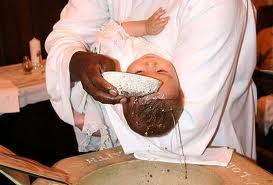
During the Vigil a new infant member entered into the Church through Baptism.  With many apologies to him and his family, I can't bring his name to mind (but he was gorgeous!).  After the little one's baptism Fr Richard held him aloft so that his new parish family could rejoice and welcome him with applause.  Fr Richard's gesture struck me as another profound symbol of hope and meaning. It seemed to say, in a sort of ecce homo, not only that here is a new Christian! - but also, behold the wonder of this human person! - ineffably precious, made in the image of God and divinised through the Incarnation of Christ, loved by his Creator so much that He redeemed Him through His own blood.  Furthermore, the little one's presence was a sign that Christ's Church, even in today's cynical, secular world where so many (as the Pope preached at his Easter Vigil) are "groping in the dark" and seemingly "unable to distinguish good from evil", is still alive and growing.

"And I tell you that you are Peter, and on this rock I will build my church, and the gates of Hades will not overcome it" (Matthew 16:18).

After Mass our younger son asked, "Why did Father hold the baby up like Simba?" (in the scene from Disney's The Lion King) - to which his older brother remarked, "Because it's 'the circle of life' " (song from same movie). Now, lest anyone should be tempted to think what a cute interchange this was, I will point out that our sons are aged 19 and 22 respectively and they were being a bit silly.  Still, they had a good point.  We were indeed witnessing the circle of life.  We were privileged to be present at the beginning of a new life in Christ entered through the door of baptism; a life which would, by the grace of God, continue nourished through the reception of Holy Communion, strengthened by grace through the Sacrament of Reconciliation, empowered at Confirmation and perhaps directed in service via either marriage or Holy Orders until it entered into eternity through the gates of Viaticum.  Through those years a particular personality would unfold, and that unfolding in itself would be a thing of wonder and a delight to see, but just now the little person held aloft was a mystery and a treasure trove of human and divine potential.  Deo gratias!

Let's pray that every newly conceived human life is seen as a treasure trove, given the chance to be born both naturally and spiritually into its rightful heritage and to unfold its riches over the years, riches of grace and virtue that he or she can finally offer back to the Father as "treasure in heaven".  For it is certain that Jesus Christ longs to hold each little human life up to His Father in thanksgiving and love just as our priest held up our tiny new parishioner last night.

* * * * * * * *

A haiku by Stella (of "Stella's Story")

Life from its starting
Maranatha, softly call
Simple precious gift

    Years ahead praying
    Maranatha, quietly call
    Answered prayers of life
 
Faith filled years passing
Maranatha, hear my call
Darkness of the soul

    Light shines with praying
    Maranatha, softly call
    God is always there

Eyes to heaven turn
Maranatha, pleading now
Autumn days are close

    Life draws to a close
    Maranatha, You are here
    Forgive my doubting
  
Alleluia!

Saturday, 7 April 2012

A Very Happy Easter...

... to both our readers! 

As we prepare to celebrate our Lord's rising from the tomb tonight we entrust the pro-life cause afresh to Him, knowing that through His victory over sin and death the unborn who have lost their lives will also rise again and that those who mourn will be comforted (cf Matthew 5:4).

"He will wipe every tear from their eyes. There will be no more death or mourning or crying or pain, for the old order of things has passed away.” (Revelation 21:4)

Sunday, 1 April 2012

Suffering - to be avoided at all costs?

As a small and poor tribute to Palm Sunday and the opening of Holy Week, here is the Editorial from today's St John's pro-life newsletter.

Holy Week... Jesus enters Jerusalem for the final days of His life, when, for our sakes, He will voluntarily shoulder a Cross as heavy as all the sins that ever were and ever will be committed, and will submit to suffering unto death.  Foolishness indeed to the world in general, as St Paul points out in 1 Corinthians, but to Christians “the power of God” – a pathway to blessings beyond imagination.

It is no different today.  Our society sees suffering as the evil to be avoided.  Death itself is preferable to it.  Not death arrived at through a process of seeing suffering through to the bitter end as Jesus did, but as an alternative, swallowed down quickly as a pill or potion or administered by lethal injection.  What happiness can there be when suffering makes its appearance on the scene?  What meaning and value can we find to our lives if they contain pain or severe physical limitations?

Seen through this perspective, euthanasia (or the abortion of a disabled foetus) becomes the compassionate – the only compassionate – option to offer the severely incapacitated.  The Catholic viewpoint, that we have no right to take our own or anyone else’s life whatever the circumstances, is seen as meaningless if not downright cruel.  Try to talk about the positive value of suffering and you are likely to be rhetorically stoned for, firstly, condemning someone to bear their pain no matter what and then for adding insult to injury by telling them suffering is good for their soul...

In fact that is the great message of Easter; that we will all find crosses, great or small, in our lives but that through faith in Christ those crosses – the things we most fear in life like pain, illness, paralysis - can be transformed into blessings.  What then is left to for us to be afraid of?  Encouraging someone to “hang on in there” is neither cruel nor pious nonsense because God “will not let you be put to the test beyond your strength but with any trial will also provide a way out by enabling you to put up with it” (1 Corinthians 10:13).  Where suffering abounds, grace abounds all the more, to slightly adapt the words of St Paul.

This isn’t an easy concept, especially as you probably have to walk some dark roads yourself before you can testify to the hidden light to be found there.  Such witnesses can be found.  Alison Davies is a sufferer from spina bifida who herself passed through a stage of wanting to die; now she works to promote a positive view of disability through No Less Human, a branch of SPUC.  Chelsea Zimmerman was paralysed from the chest down in a car accident whilst still a teenager; she is passionately pro-life and writes an inspirational blog, Reflections of a Paralytic.  Alison and Chelsea are witnesses to the light, people who have made – and are making – a difficult journey and learning along the way to value life all the more.  There are others like them, finding blessings and meaning blossoming like those hardy wild flowers one sees obstinately thriving between the rails of train lines or on rock faces.

Every flower must receive water and nourishment from somewhere, however.  As we meditate on what Holy Week can tell us about suffering and grace, can we also respond to the challenge it gives us?  Like Simon of Cyrene, Veronica and the women of Jerusalem, do we have hearts big enough to help shoulder the crosses of those who suffer so terribly -  showing them what comfort we can, weeping with them when the pain feels too much and, well, just loving them?  True compassion will always try to offer a reason to live, not a way to die.

*Perhaps it should be mentioned that this editorial is discussing unavoidable suffering.  Of course it is our duty to alleviate suffering and seek a cure wherever possible; but not at the price of deliberately taking a life.